News
SMC Previews Nursing Program
Published on March 23, 2026 - 4 p.m.
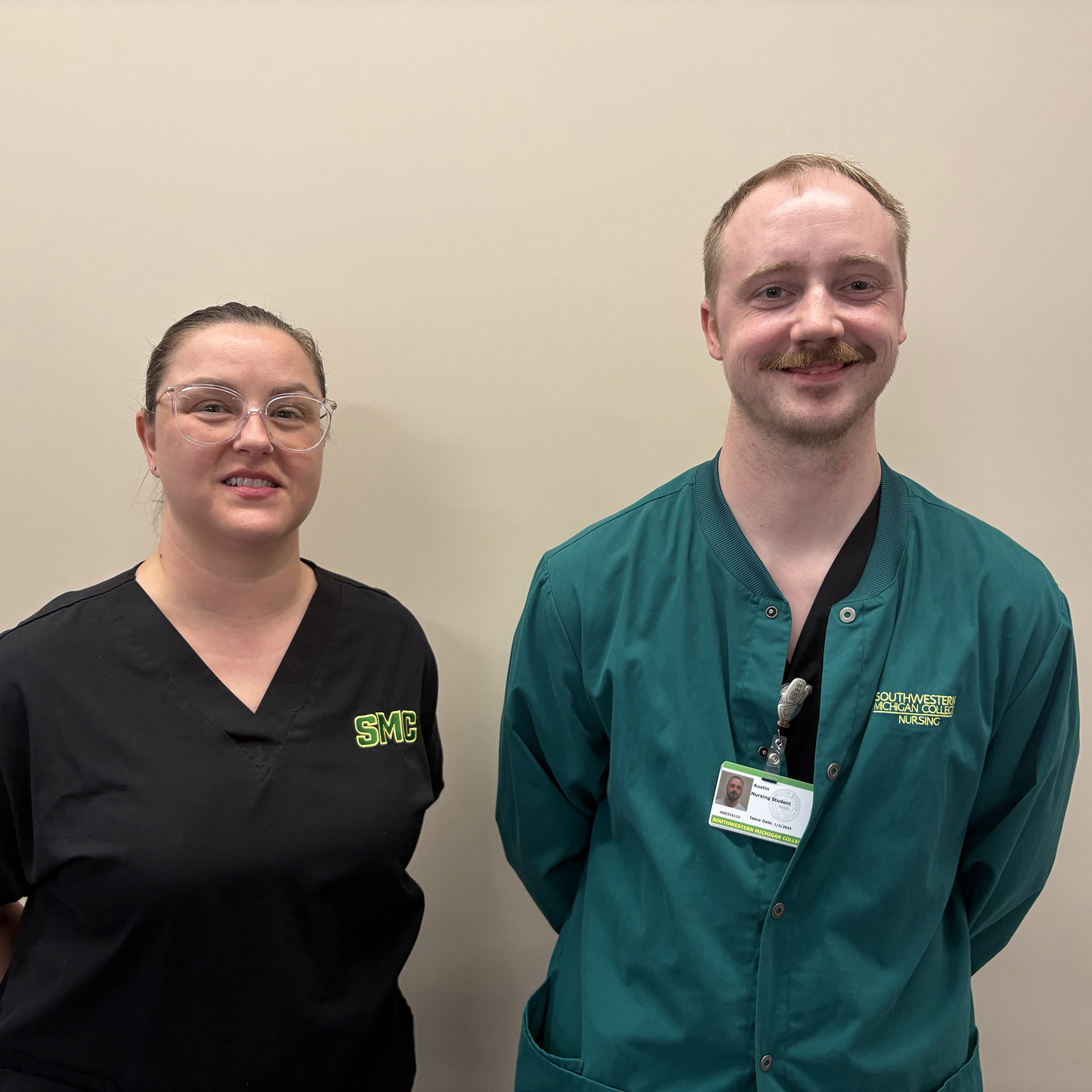
Former Army medic Austin Evans and Buchanan’s Jaime Meahl, following her twin sisters into nursing, offered student perspectives at March 19’s Southwestern Michigan College program preview.
Meahl graduates in May. Evans is halfway through the flexible, nationally-accredited program.
Had she not been able to attend part-time while working, “I probably never would have done it,” said Meahl. “I’ve been exposed to lots of facets of nursing through this program. Some I hadn’t been aware of before. I’m going into ER, hospice or babies. I might get my bachelor’s and teach because I like sharing what I’ve learned. My sisters came to this school, which led me here. Dr. Kennedy, now dean, was their teacher.
“The longevity people have with this program speaks to the quality. Everyone cares a lot. You feel that going through with individual attention and a nursing success and retention coach.”
Mollie Grabemeyer, who is not a nurse, draws on her background in psychology and holistic health to manage stress, reduce anxiety and remove barriers.
“There are so many resources,” from tutors to a monthly learning community for guest speakers, workshops and networking.
Evans, 30, qualified for the Michigan Reconnect program for free or reduced tuition for residents 25 and older. “I’ve paid like $35 out of pocket so far.”
“What I enjoy about this program,” Evans said, “is the sense that they really want to make good nurses. This program makes it very easy to be successful because you feel prepared for actual nursing, which is so broad you can go anywhere. I like being in one of the most respected professions. I’m a nerd when it comes to continual learning. Being a professional helper is fulfilling.” He went to school in Constantine, Elkhart and Edwardsburg and is engaged to be married.
“Caring for everyone from NICU children to geriatric patients in long-term care facilities is an opportunity that doesn’t come to many people,” Evans said. “I plan to work in an emergency department. The action, the variety of patients. I’d like to get my master’s at some point and work with the (Veterans Administration). I would love to do it all. We have other medical fields if you find out nursing is not your jam.”
Dean Dr. Melissa Kennedy, an SMC graduate who joined the faculty in 2011, elaborated on her program’s flexibility.
“You can go fulltime. You can go part-time. You can ebb and flow as life happens,” she said. “It’s up to you because our goal is to get you through nursing school. You have the opportunity to earn stackable credentials. After first semester, you’re eligible to sit for your CNA licensure exam. After second semester and a seven-week class, you’re eligible to sit for LPN licensure. After third and fourth semesters, you sit for RN.
“We look for a 2.75 GPA on five prerequisite courses to accept you into our program. Also unique to SMC among nursing programs in our service area is that we do clinicals in both Indiana and Michigan. You get to experience two major health systems, Beacon and Corewell.”
Department Chair Rona Goodrich, a nurse for 34 years, including 17 in home care, joined SMC 10 years ago. She teaches pharmacology and medical/surgical nursing.
SMC admits 80 nursing students each year — 40 in Fall (applications due June 1) and 40 in Spring (Nov. 1). In the SMC Nursing Building, sixteen beds are set up like hospital rooms. The four-room sim lab has two control rooms.
“Simulation promotes critical judgment and thinking,” Goodrich said. “The instructor is not in the room with students, but in the control room with the sim lab coordinator (Victoria Christen) so students can work it out on their own. Based on how students respond, we can cause blood pressure to drop or we can make the patient be confused. It’s a safe place to learn. Our manikins can talk and answer questions. We can program different lung or heart sounds. With Hal Jr. (one of the manikins), you can poke his finger and get ‘blood’ so you can check his sugar with a glucometer. With ‘Big Hal’, you can do CPR and defibrillate, or do urinary catheterizations. The birthing manikin has different bellies and the baby she delivers is functional, too.”
“The first seven weeks, students learn skills — blood pressure, vital signs, bathing, transferring, putting in catheters,” Goodrich continued. “The second seven weeks is at a long-term care facility with real patients. We do three med/surg rotations — first, on a post-op floor, second on an oncology floor and third, a cardiac floor. We also do some specialties — psycho-social, pediatrics and obstetrics.”
Manager of Admissions and Adult Recruitment Coordinator Ben Spencer provided an overview of the admissions process and opportunities for financial aid. Twenty-seven attendees toured the simulation lab to see the manikins in action.